|
|
|
READ THIS before submitting your abstract
To submit an abstract, first you must Create an Account (if you do not already have one) :
https://micro2026.sciencesconf.org/user/createaccount
Once your account is created, login to the site. The menu link for "Abstract Submission" will become available to you. Follow the instructions on the Abstract Submission page to submit your abstract.
As you prepare your abstract for MICRO 2026, here are a few tips :
. Your abstract may be up to 300 words (max).
. End your abstract with one sentence that reflects on the broader relevance of your work.
. Review the Topic descriptions below and select 2-3 of them when you submit your abstract.
. Review the "Presentation Types" page to determine which kind(s) of presentation you are most interested in contributing to MICRO 2026. Please note we will do our best, but your abstract may be selected for a different presentation type than what you propose.
. Abstracts for MICRO 2026 must be submitted by : 20 May, 21h -time.
. The MICRO 2026 Scientific Committee's review process starts : 23 May 2026.
. All presenters will be notified about their abstract's acceptance by : 5 June 2026.
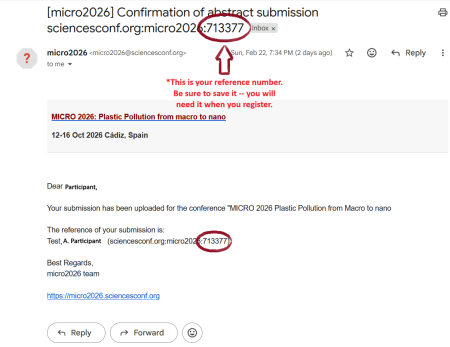
. **IMPORTANT** : Save your 6-digit Abstract Reference Number & Confirmation Email -- you will need these when you register for the conference. Registration will open in March 2026. Example: sciencesconf.org:micro2026:XXXXXX (this will be the 6-digit number)
Topic Descriptions, in alphabetical order :
. Ecological impacts across scales: From toxicity to ecosystems
This theme covers ecotoxicological and ecological effects of plastics across biological levels: from cellular responses to food webs and ecosystem processes. It includes laboratory, mesocosm, field, and in situ studies, including impacts on endangered or protected species.
. Governance and policy: From local initiatives to global frameworks
This theme focuses on policy development, regulatory approaches, and science-policy alignment. It includes plastic regulations, governance effectiveness, monitoring to evaluate policy ambitions, and data credibility in decision-making.
. Integrative approaches: Connecting disciplines, scales, and knowledge systems
This cross-cutting theme welcomes contributions that integrate multiple dimensions of plastic pollution. It includes socioecological systems, One Health frameworks, interdisciplinary modeling, economic data integration, and comprehensive system-level analyses.
. Measuring the plastic planet: Understanding sources and occurrence
This theme focuses on how we detect, quantify, and monitor plastics across environments. It includes environmental occurrence studies, mass quantification, remote sensing, long-term monitoring, and efforts to establish robust global or regional plastic budgets. Contributions on analytical harmonization and standardization also fit here.
. Plastics and health: Plastics in socioecological health systems
This topic focuses on human exposure and health implications of plastics, including micro- and nanoplastics. It also welcomes integrated One Health approaches that link environmental contamination, plant and animal health, and human well-being.
. Plastics as chemical systems: Additives, associated pollutants, and complex interactions
This topic recognizes plastics as complex chemical mixtures. It includes plastic additives and other plastic chemicals, polymer chemistry, leaching, sorption/desorption processes, and interactions with surrounding pollutants and organisms in multi-stressor environments.
. Plastics in motion: Transport, fate, and source-to-sink dynamics
This topic covers how plastics move across systems and scales - from source to sink. It includes transport modeling, ocean-atmosphere exchange, aggregation processes, and movement across environmental interfaces (soil, water, air, cryosphere).
. Plastics in the Anthropocene: Geological signatures and long-term records
This theme explores plastics as geological markers and agents of Earth system change. It includes plastic rocks, sediment core studies, microplastics as Anthropocene markers, and the role of plastics in geological and biogeochemical cycles.
. Production and consumption: Upstream drivers and systemic change
This topic addresses plastic production and consumption patterns, economic impacts of plastics, circular economy strategies, and upstream prevention measures. It includes reuse/refill systems, alternative materials, bans and reduction strategies, and evaluation of ecological and socio-economic impacts.
. Societal transformation, communication and culture: Education, arts, ethics, and change
This topic addresses how society understands and responds to plastic pollution. It includes education at all levels, ocean literacy, arts, ethics, social behavior, outreach, and cultural transformation.
. Technological and nature-based solutions: Prevention, mitigation, and remediation
This theme focuses on technological and ecological interventions to reduce plastic pollution. It includes removal technologies, wastewater treatment improvements, monitoring tools, remediation strategies, and nature-based approaches.
. Transformation: How plastics change in the environment
This theme addresses physical and chemical transformations of plastics. It includes weathering, fragmentation, abrasion, biodegradation, and the formation of micro- and nanoplastics, as well as biodegradable plastics and their persistence.
. Other contributions that do not fit the themes above.